
Ten years ago I stood on Harrison Stickle in a whiteout with Storm Abigail closing in, and Pavey Ark beat me that day. I’ve told that story before: the compass I couldn’t read, the night I very nearly didn’t find my way off this massif at all. I picked Pavey Ark up easily enough not long after, the ordinary way round from Thunacar Knott, but that never felt like a proper answer to what happened here. This time I’m sneaking up on it: Jack’s Rake, straight up the crag’s front face, the line this fell always deserved.

Jack’s Rake and Pavey Ark, Langdale
Route Map and GPX
Storm Abigail beat me to Pavey Ark ten years ago, and I’ve fancied coming back to do it properly ever since. Up through the crowds on Stickle Ghyll, a lunch stop at the tarn, then the line everyone talks about: Jack’s Rake, straight up the crag’s front door.
HOW TO USE THE MAP
For the best ‘experience’ using the map, click on that box in the top left to go ‘full screen’ (Esc to come back). Click icons to reveal details. Zoom by pinching or hold CTRL and roll the mouse.
Route at a glance
- Distance: 4.9km (3 miles)
- Ascent: 625m (2,050ft)
- Time: 4 hours
- Start: National Trust car park, New Dungeon Ghyll, Great Langdale
- Difficulty: Difficult (Grade 1 scramble)
- Map: OS Explorer OL6
- AW Book: Central Fells
Wainwrights
- Pavey Ark (700m / 2,297ft)
Field notes
- Terrain: Steep zigzag path up Stickle Ghyll to the tarn, then a Grade 1 rock scramble up Jack’s Rake with one awkward chimney move and a climb ‘around’ an exposed rock
- Navigation: Straightforward to the tarn on a well-walked path; the rake itself needs a good eye for the line, half way up (just past the tree) keep going along the cliff face instead of being tempted to climb to the right
- Parking: National Trust car park at the New Dungeon Ghyll, or a layby further down the valley if you’re lucky
Watch out for
Grassy ledges on the rake look walkable but aren’t. Several fatal falls have started exactly there. Test every hold first and always keep at least three points of contact.
Why do it
A proper scramble with lots of exposure, a famous rowan tree halfway, and a Wainwright waiting at the top. You’ll feel like you’ve really achieved something.
Dog friendly?
Seen people taking dogs up but in my opinion, no. A Grade 1 scramble with a chimney and narrow ledges: no fair way to get a dog safely up this.
Is this walk for you?
Jack’s Rake has a reputation, and it’s earned. If you’re solid on Grade 1 rock, keep a cool head over a drop, and treat every wet hold with proper suspicion, it’s one of the best few hundred feet of scrambling the Lake District has. If you’ve never scrambled before, or heights turn your legs to string, this blog is entertainment only, there’s a path round to the right of the fell up by a stream. Plenty of good walkers do exactly that, and there’s no shame in it. Or, go with a guide, you’ll learn more than you think and become a better hiker.
Back into Great Langdale
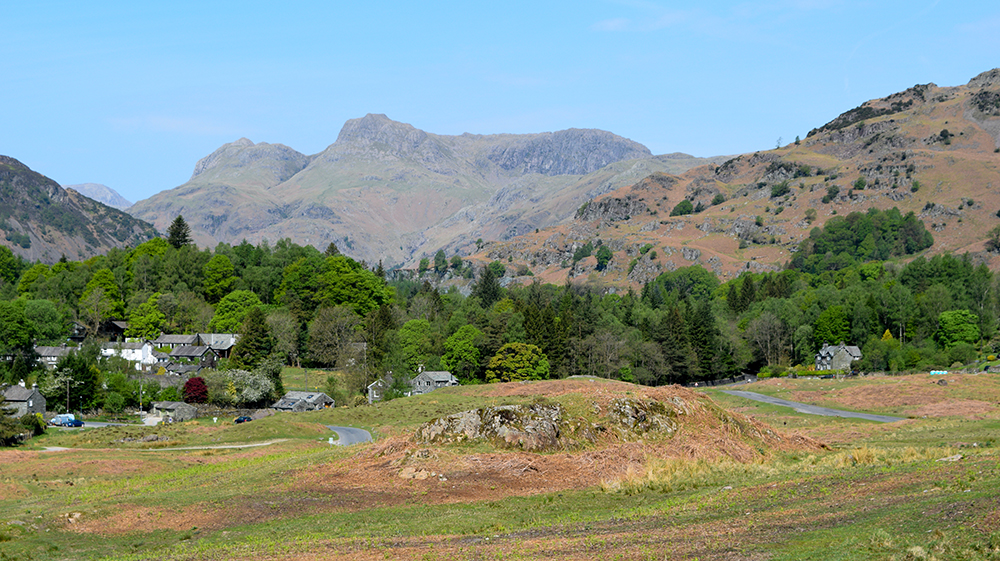
You know you’re properly in when you cross the cattle grid everyone who’s driven this road remembers: the valley closes in either side of you, the Pikes lined up dead ahead like they’ve been waiting on you specifically. It never gets old, however many times I’ve come up this road I always have to park up here and take it in.
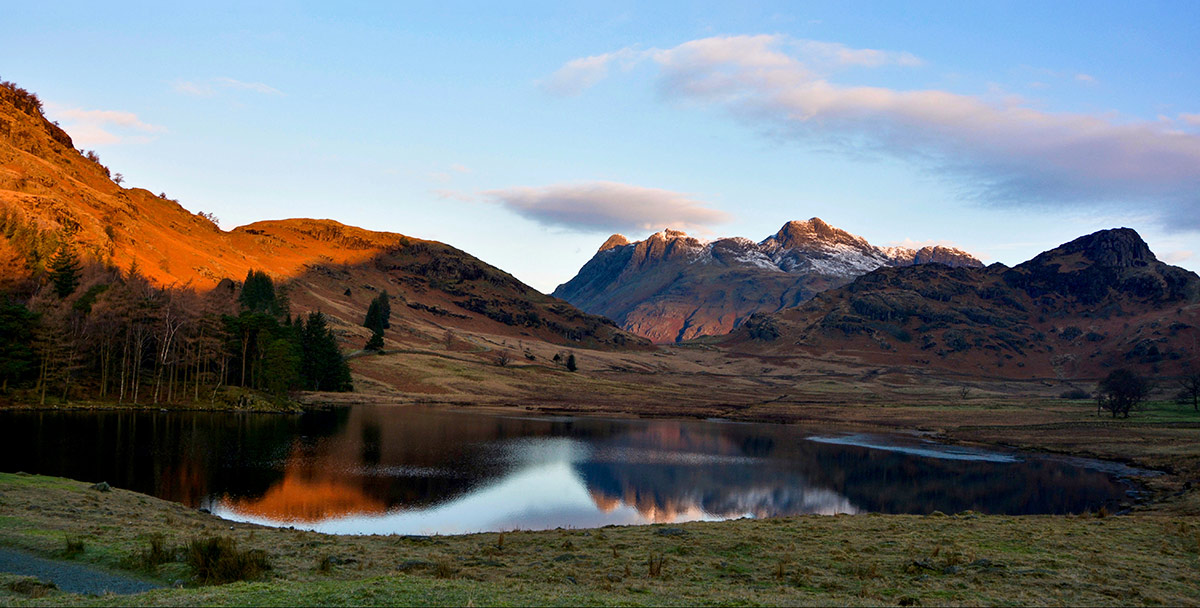
If you’ve come in past Blea Tarn on the back road instead, you’ll already have had your first proper look at what you’re taking on: the Pikes stood up in a row across the water, looking a lot further away than they turn out to be. It’s the view most people see when they Google the Langdale Pikes, iconic.
Park up at the New Hotel, the National Trust car park at New Dungeon Ghyll, and Stickle Ghyll starts right behind the toilet block, a stepped path that a few thousand pairs of boots a year have worn smooth. It’s not a quiet start to a walk, but it’s a good one.
After meeting John in the car park and signing up to the National Trust instead of paying the £10 parking fee, we grab our bags and head on in.
Up Stickle Ghyll
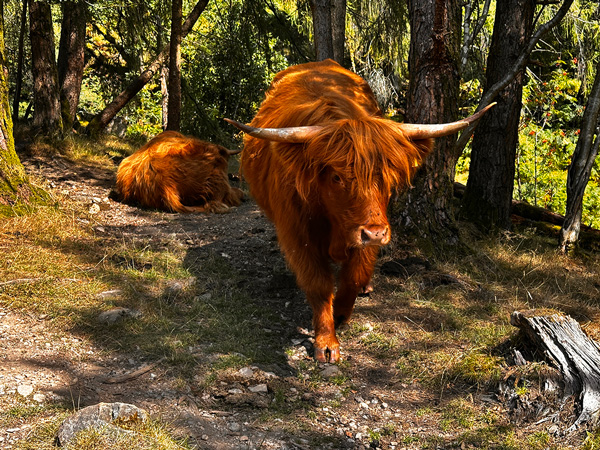
Since I was here last, there seems to be half a dozen Highland cattle chilling out by the gyhll. Great shaggy things sitting in the shade under the trees, entirely unbothered by walkers until I get close for a photo.
Not far above the cattle, a footbridge crosses the beck, a good spot to stop pretending you’re not out of breath and have an actual look around. What you’re following up the hill isn’t just scenery, either. At this point the National Trust runs a small hydro-electric turbine, about 100kW, drawing on the same water dropping past you to help power Sticklebarn, their pub down in the valley. You’re walking up the side of a working power line and it looks like nothing more than a stream.
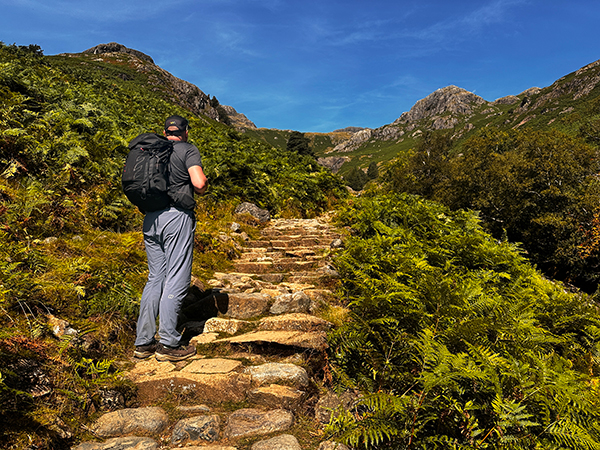
We take the western path up alongside the ghyll rather than crossing it, away from the ghyll scramblers and day trippers. Pavey Ark starts showing itself properly in no time: that long dark tier of crag with the tarn sitting under it, and somewhere on its face, a line you can’t quite pick out yet.
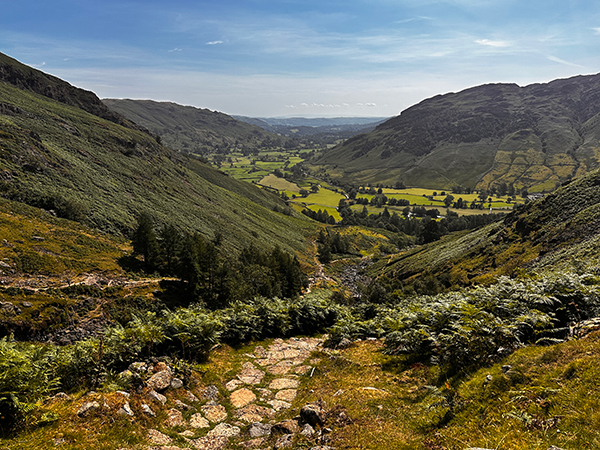
Turn round on the way up and the whole of Great Langdale opens out behind you, all the way down to Windermere on a clear day. It’s one of those views that makes you stop more often than your legs strictly need you to, although, it’s a welcomed break for me.
I might normally sit here for half an hour but when I’m out with Beamo I don’t get as many breaks as I would clock up if I were alone. Boots on, bag on, crack on is his motto, and crack on is what we do.
Stickle Tarn
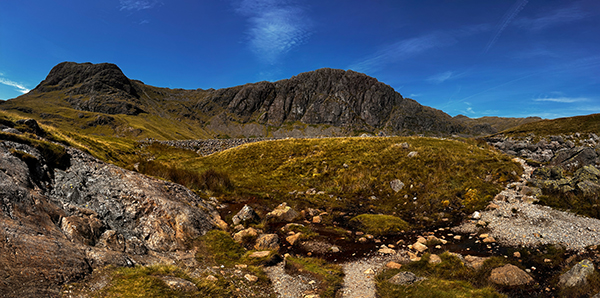
Coming to the top of the path, everything comes into view. Harrison Stickle to the left following the drooping col over to Pavey Ark. It’s already a roasting hot day and my thoughts of summiting all of the Pikes today are disappearing already like the wisps of moisture in the sky. We came to do Jack’s Rake. ‘The Langdale Pikes’ should be saved for a day by themselves.
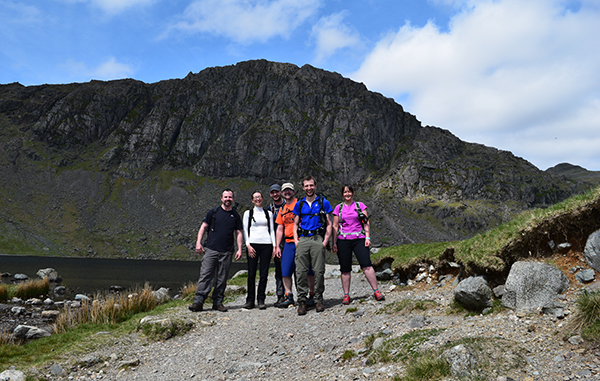
It’s been 10 years since I first climbed this beast, on another beautiful day in May. I did it with a group along with the five ‘Pikes’ – Pavey Ark, Harrison Stickle, Thunacar Knott, Pike Of Stickle and Loft Crag. We called it Jake’s Rake until we came to put it in a post at the Walker’s Bar! Seems thick now. Not one of us must have looked at a map, I have the excuse that I was just following locals.
There’s a particular kind of quiet that comes over a group of walkers standing at the bottom of Stickle Tarn looking up at a line neither of them has done before. Good nerves, everyone should fear dying of course but every time I just feel excited, it’s such a thrill.
John’s no stranger to the rake either. For a while, he took clients up here for a late night stroll, a challenge he called Midnight Madness.
Stickle Tarn itself is a proper corrie, a bowl gouged out of the mountainside by a glacier that’s long gone, filled in behind by meltwater and rain ever since. What you’re looking at now is bigger than that natural bowl, though. In 1838 they built a dam across the outflow to raise the water level and keep a reliable head of water running down the ghyll to the gunpowder works at Elterwater. That same drop in the beck now quietly runs the little hydro turbine we passed lower down. Water that was once dammed to grind gunpowder is now dammed to keep the lights on in the pub. Langdale doesn’t waste much.
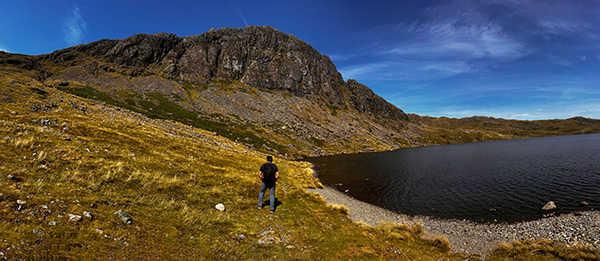
We take the path to the left of the tarn and it’s a good place for a stop, anyway. We have a bit to eat and I get the Sawyer filter out to top up my water here: nothing worse than getting halfway up a scramble in the sun and you’re fighting dehydration for the sake of carrying a litre of water. Pavey Ark’s whole front wall is right across the water from you now, and Jack’s Rake is the one obvious diagonal line running up it, exactly where Wainwright said it would be.
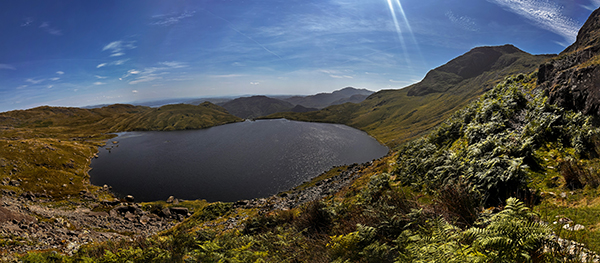
The path round the tarn’s edge to the foot of the crag is where the day quietly changes gear. Behind you the tarn’s gone flat and silver, in front of you the rock’s gone vertical, and somewhere in between the two you stop being a walker for an hour and become a scrambler instead, that moment you take a deep breath and nod your head – let’s do this.
Jack’s Rake
The rock underfoot on Pavey Ark is Borrowdale Volcanic Group, the same violent ancestry as most of the central fells, laid down around 450 million years ago as ash and lava from volcanoes that don’t exist anymore. Up close, the crag is a jumble of old pyroclastic flows: volcaniclastic sandstone, lapilli tuff, breccia, chunks of rock welded into other rock by heat and pressure and time. It looks solid. Mostly, it is. Jack’s Rake finds the one line of weakness in all of that and follows it straight up.
Wainwright called it “difficult and awkward,” and then, almost as an aside, admitted there’s curiously little sense of exposure for most of it: the rake is cut into the crag deep enough that the rock itself does a good job of hiding the drop from you. That’s exactly how it feels starting out: a groove in the mountain, steep underfoot, walls either side, nothing that looks like the void everyone warns you about. Not yet.
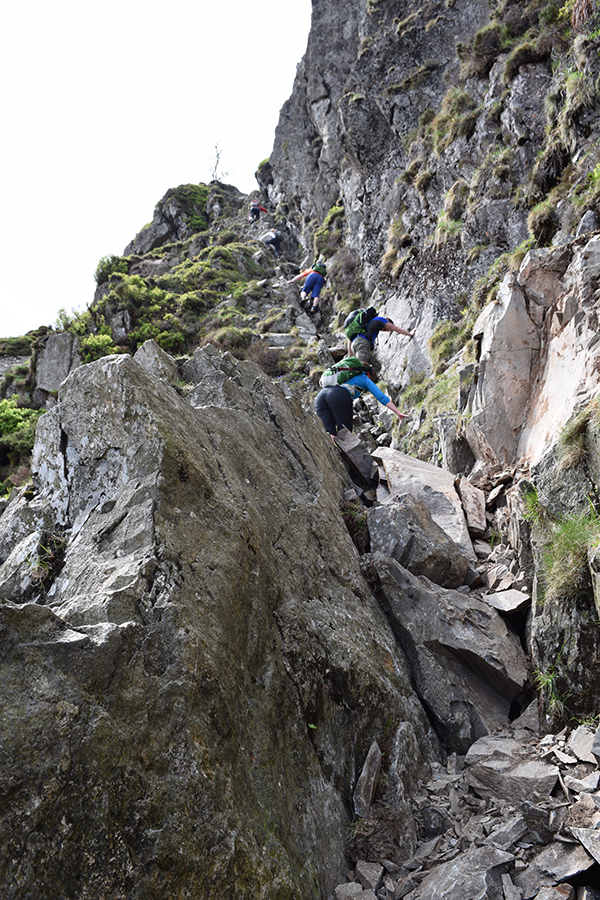
First time on the rake, it takes about four moves to understand why people talk about it the way they do. It’s not hard, exactly. It’s committing. Once you’re in the groove, going back down is worse than carrying on, so you carry on.
This photo shows the channel my earlier group, and a hundred thousand adventurers before them, climbed.
You’re in climbing mode now, mindful that you must keep three points of contact at all times. This first half, up to the rowan tree, is safe enough. You’re cradled by the wall to your right and the rock to your left, looking for those beautiful hand holds giving you confidence on every lift. Then an exposed section reminds you – it all moves!
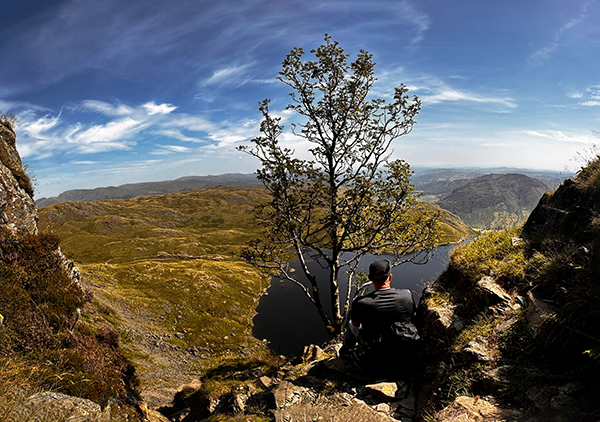
About seventy-five yards up, further than it sounds when you’re on all fours, you reach the rowan. It’s rooted in almost nothing, a crack full of its own leaf litter and a couple of centuries’ worth of stubbornness, and it marks one of the trickiest steps on the whole rake: usually wet, usually greasy, right where you need your feet to behave. Everyone who’s done Jack’s Rake has either taken a photo of that tree or kicked themselves afterwards that they were ‘too in the moment’, and now so do we. John takes a seat next to it, which is either a nice piece of composition or him needing a minute. Possibly both.
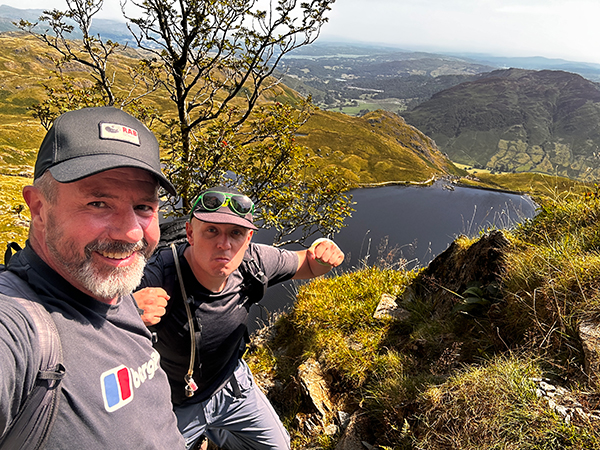
Past the tree the rake settles into a rhythm: up a step, round a jammed chockstone, up another step, the tarn dropping further below us with every one of them. This is the bit where the exposure Wainwright promised finally shows up, in dribs and drabs, never all at once.
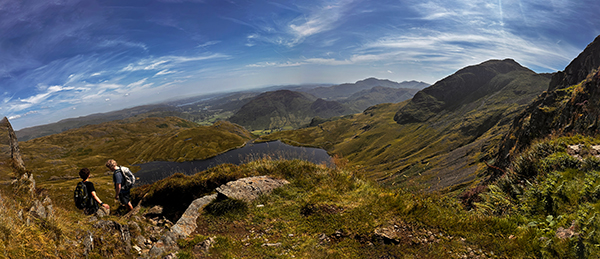
Look back down from here and you can see exactly who else made the same decision today: a thin line of walkers strung out below us on the same groove, all committed to the same up-only logic. Grade 1 scramble or not, Jack’s Rake on a clear summer Saturday is not a lonely place to be. These two young adventurers hang around for experience to lead the way (they explain later).
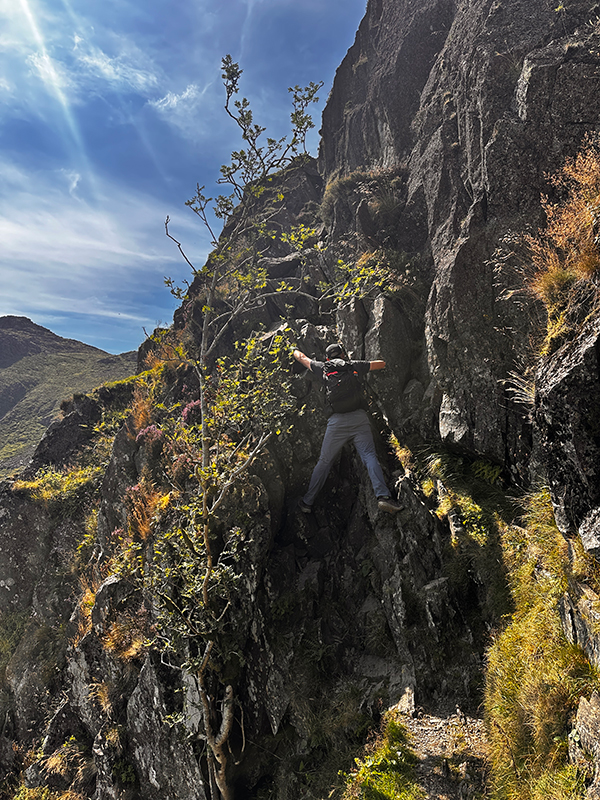
The second half is where the rake earns its warnings properly. A short, steep chimney forces an awkward bridging move, polished shiny by ten thousand pairs of boots and usually running with water regardless of the weather below. It’s the one place on the whole route I’d tell anyone to actually stop and think before committing: test the holds, trust your feet more than your hands, and whatever you do, go all in and enjoy the ride.
When you have a chance to take a breather, do it, and if you need to, take one step at a time.
Take it in though. Experience it because once it’s done you probably won’t go back for that photo or that view.
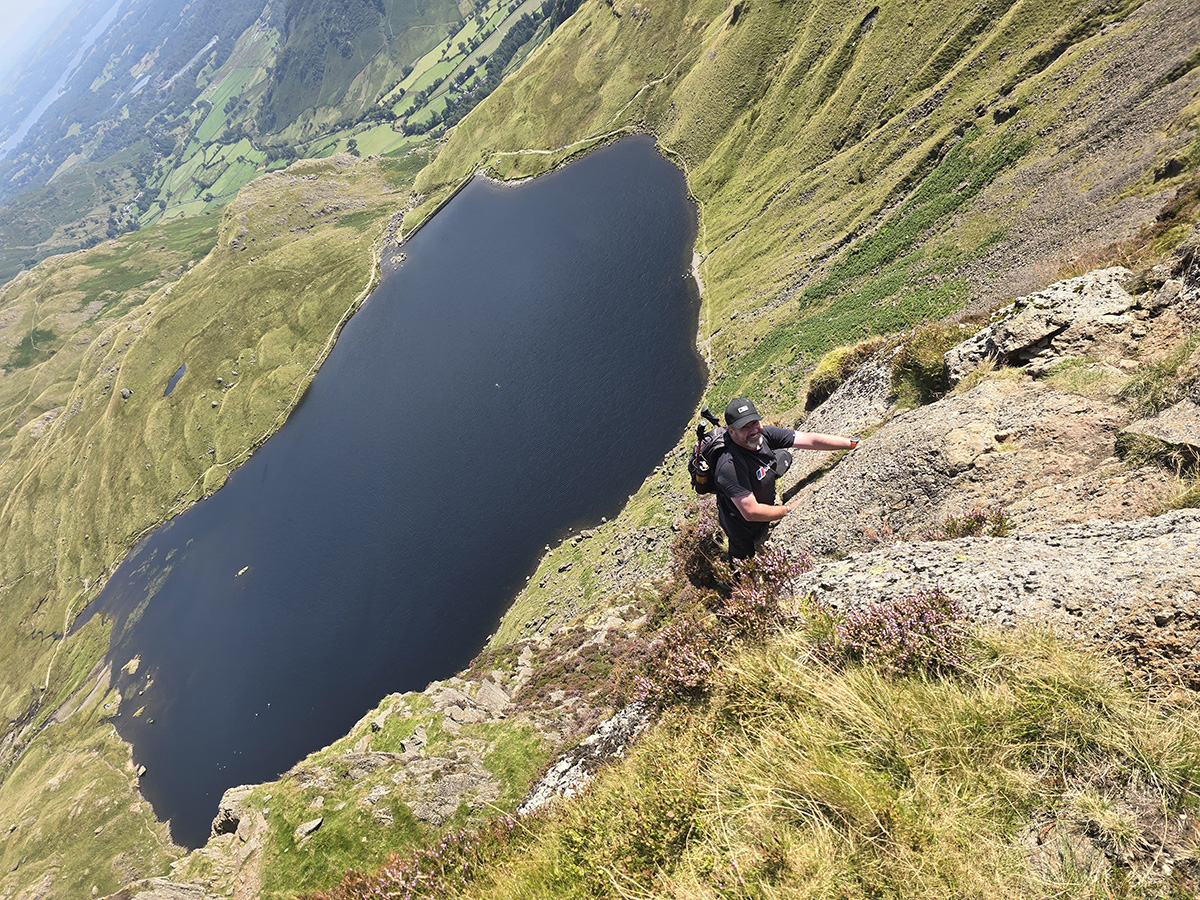
John gets a photo of me near the end and it looks like I can just walk this bit easy. In fact, it’s the hardest part. The exposure is cruel (if you don’t like heights this is your worst nightmare) and to get over that breccia boulder you have to climb out around it then pull yourself up with what strength you have left in your arms.
Once you’re over that, the scrambling is pretty much done. Just a tricky walk up to what you might call solid ground. In fact, it’s a good job this is all solid ground and that the hand holds you’ve found on the way up were there when you needed them.
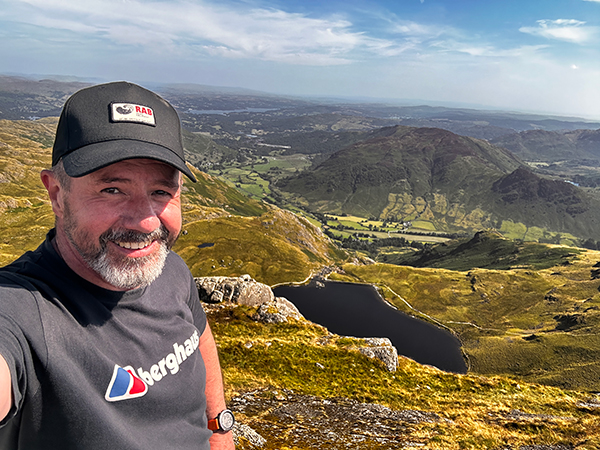
And then, the way these things always seem to end, it’s just over. One more pull and you’re standing on easy ground on Pavey Ark’s summit plateau, tarn a long way below now, grinning like idiots, both of us. Whatever the rake takes out of you on the way up, it gives back the moment you’re stood on top of it.
It really is the most rewarding sort of day to do this, a beautiful sunny, warm, clear summers day and the views over the Lake District to die for.
Pavey Ark
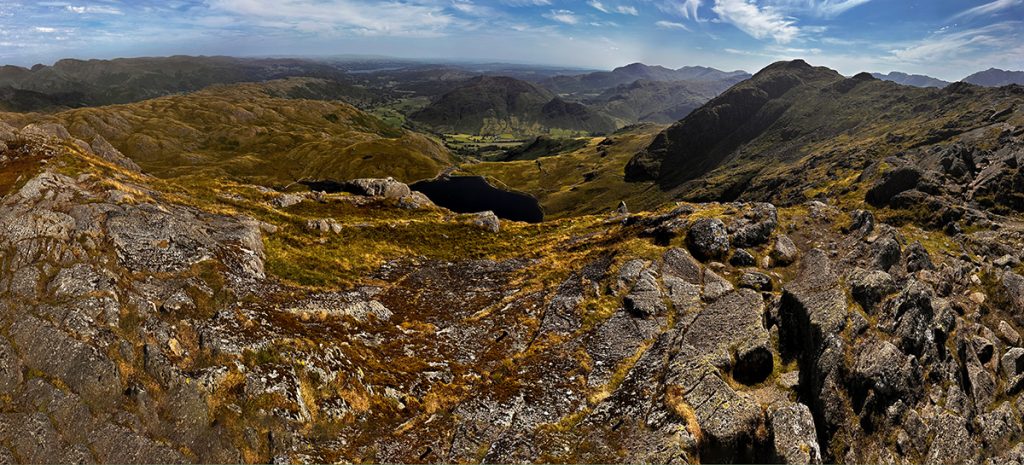
Although I’ve been on this summit a number of times from all directions, it’s always best sneaking up on it from the cliff face of Jack’s Rake. I find peace on these tops so I sit for a while taking the vesta in. Across the Great Langdale valley, above Stickle Tarn you can see the obvious Windermere and below that Elterwater, the bumpy ridge that runs away from you to the left leads over Blea Rigg, terminating at Silver How with the green Loughrigg Fell beyond and Rydal Water to it’s left, surrounded by trees.
Straight over the valley you can see Blea Tarn with the stunning Side Pike blocking your view somewhat, Lingmoor Fell to the left and Pike of Blisco to the right, with the Coniston Fells behind that.
To the far left in the photo, there’s a darker bump at the back which is St Sunday Crag, the larger lump to it’s right is Fairfield. If you’ve been to these places these views connect the dots and remind you of amazing adventures you’ve had, if not it’s wonderful to imagine what could be on the way in the months to come.

The 214 Wainwrights Checkmap
Pavey Ark went on the map years ago, the easy way. Today’s the version of it I actually wanted, done properly by Jack’s Rake. If you’re chasing all 214 yourself, or just want to see how far a Langdale round like this one takes you, this is the map I use to keep score.
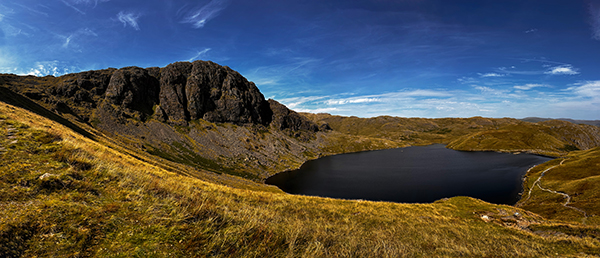
For now, anyway, I have to drop down to the col in between Pavey Ark and Harrison Stickle to descend to the tarn via a knee pounding boulder-infested path, where I rendezvous with my buddy who set off on a run when I was on the summit, he’s lying down soaking up the 34 degree afternoon sun.
I replenish my bottle and we head down by the gyhll, this time to the left (east) and a half-hour reflective walk firstly to the pub for a pint, then to the Ambleside and steak pie.
Read next

The Langdale Pikes and Storm Abigail
The first time I stood in this valley, before Jack’s Rake, four Wainwrights and a navigation lesson I’ve never forgotten, the walk that started all this.
YOU MAY BE INTERESTED IN

Helvellyn and Striding Edge
Come with me up to Helvellyn via Lakeland’s most popular Edge and down it’s neighbour over Catstycam, another adventure you’ll never regret.